
Summary
- Improved crop performance: Grower-reported improvements in growth rate and plant quality attributed to Gardin-informed decisions.
- Optimised supplemental lighting: Identifying signs of malate depletion to reduce unnecessary lighting and energy consumption.
- Plant-driven growing strategies: Using real-time plant feedback to refine lighting, screens, CO₂, fogging
Transforming Commercial Orchid Growing with Plant Feedback
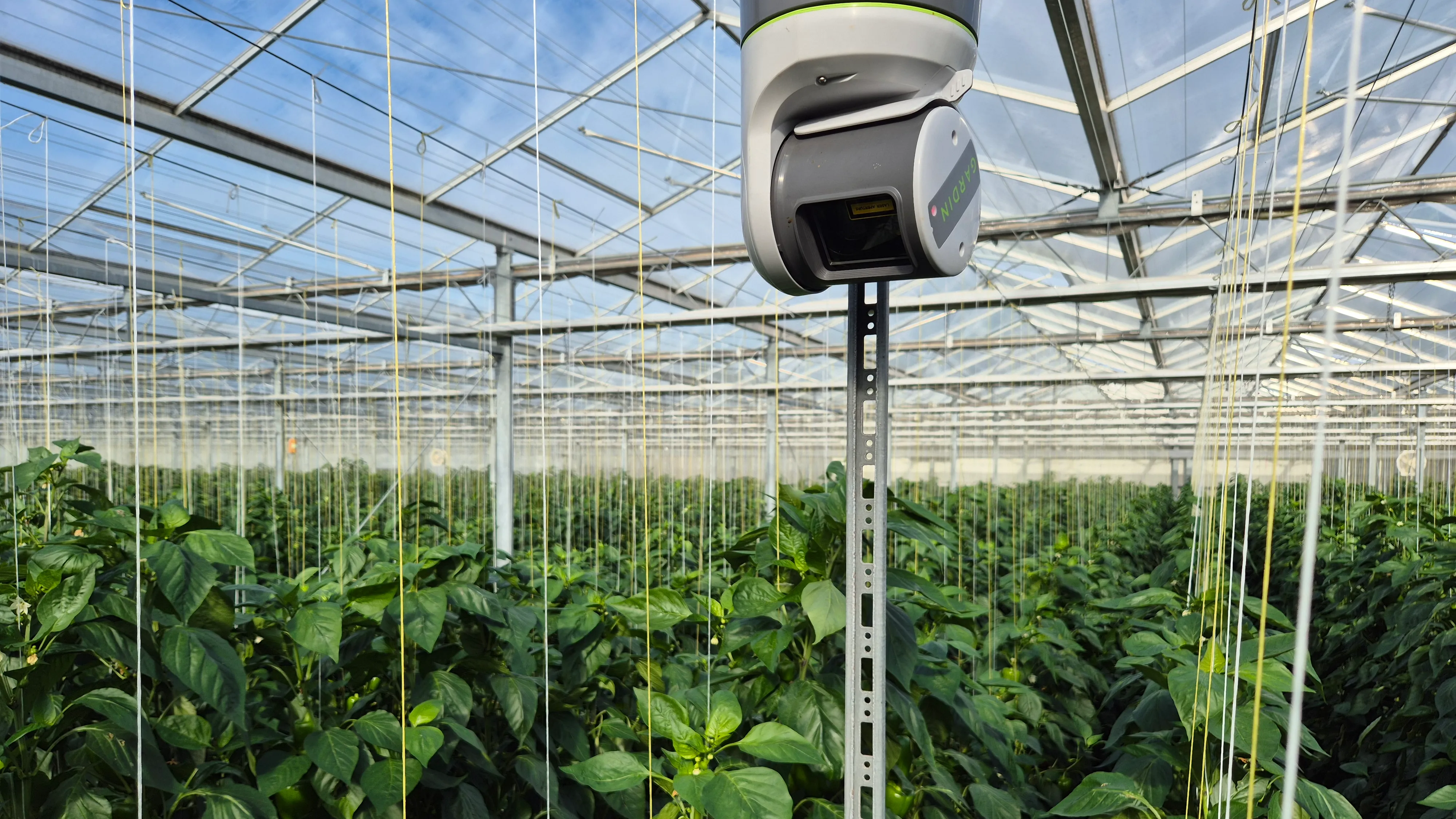
For orchid growers, greenhouse climate data shows what conditions the crop is experiencing. At JMP Flowers, Gardin adds another layer by showing how the plants themselves are responding.
Gardin sensors are used alongside PPFD, temperature, LED lighting, CO₂ and screen data to understand when Phalaenopsis crops are efficiently using available light, and when that efficiency begins to decline.
“The Gardin sensor has become a game changer for me. As an orchid grower, I have always had different hypotheses to test, but it was difficult to see the plant’s physiological response in real time. By combining Gardin data with PPFD, temperature, LED lighting, CO₂ and screen settings, I can better understand when the crop is efficiently using the available light. We are now entering an era where greenhouse management is based not only on climate data, but increasingly on the plant’s response.”
Andrii Panfilov, Team Leader of Plant Team, JMP Flowers
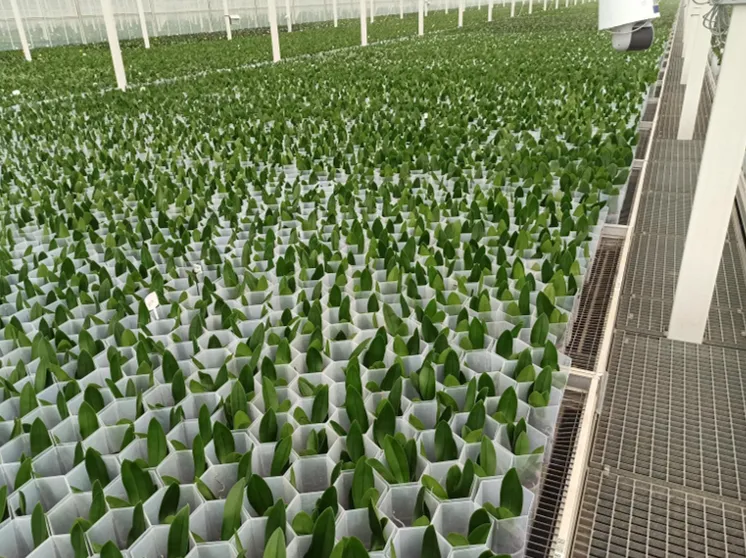
Image: Gardin sensor (top right) monitoring orchids in commercial production at JMP Flowers.
Moving Beyond Fixed Lighting Targets
Phalaenopsis orchids use CAM photosynthesis, taking up CO₂ mainly at night and storing it as malic acid for use during the following day. As these reserves are depleted, the crop can become less able to use additional light productively. Independent research by Plant Lighting has demonstrated Gardin’s ability to detect the transition associated with malate depletion across different Phalaenopsis cultivars and growing conditions.
One of JMP Flowers’ first questions was whether its lighting strategy was making full use of the crop’s photosynthetic potential. As team leader of Plant Team, Andrii Panfilov explains:
“In practice, we regularly analyze Gardin data alongside PPFD and greenhouse climate conditions to identify when the crop’s light-use efficiency starts to decline. When we observe patterns suggesting malate depletion, we can adjust our supplemental lighting strategy and avoid providing additional light that the plant may no longer use efficiently.”
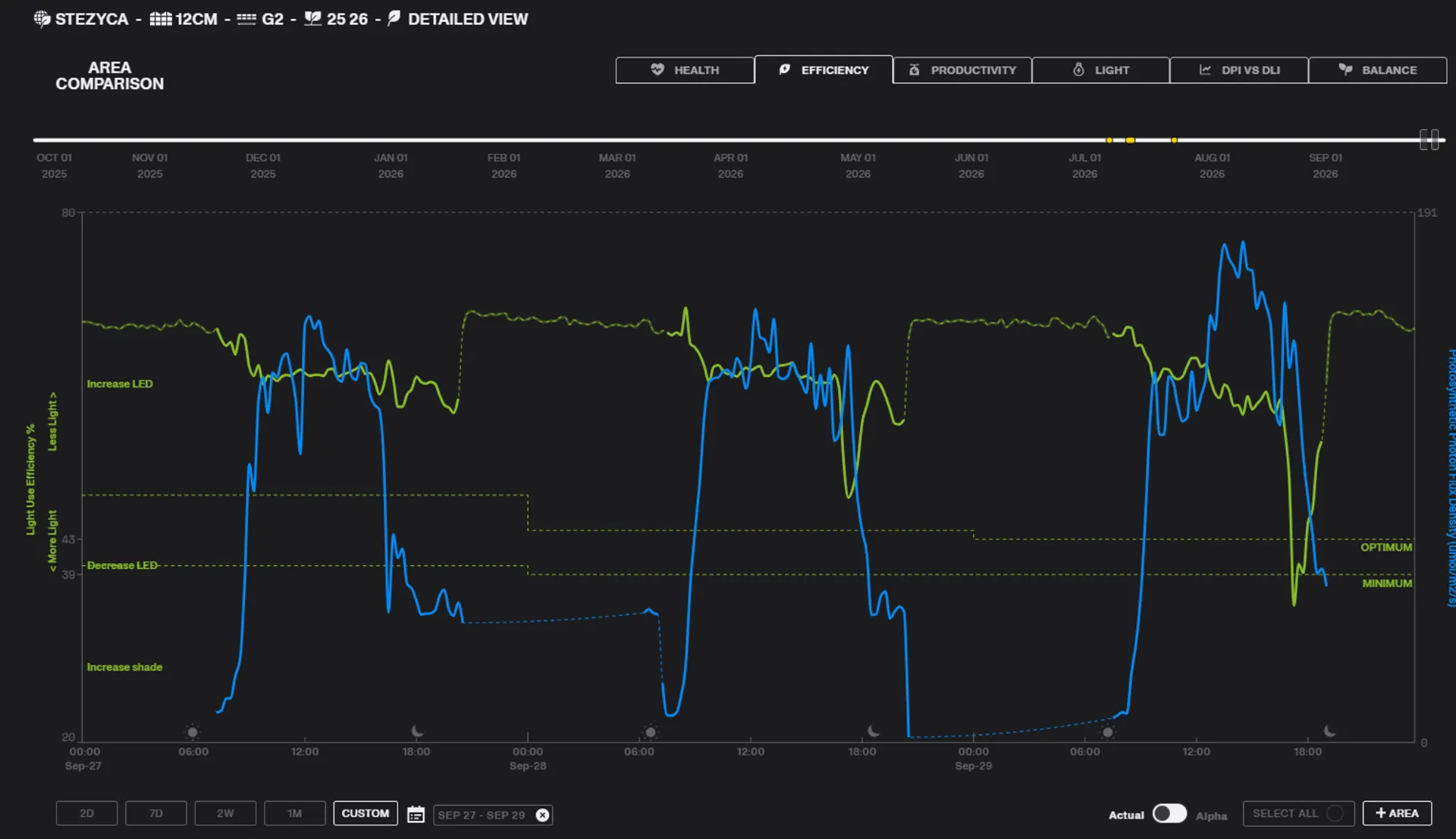
Image: Photosynthetic efficiency (green) and light intensity (blue) over three days, presented in the Gardin app. On 27 and 28 September, photosynthetic efficiency remained relatively stable, and the photoperiod was extended with supplemental lighting. On 29 September, efficiency declined sharply before sunset, consistent with malate depletion, and no additional supplemental lighting was provided.
Gardin data from 27–29 September 2026 demonstrates how JMP Flowers uses plant feedback to inform its lighting strategy. On 27 and 28 September, the crop maintained relatively high photosynthetic efficiency towards the end of the day, and supplemental lighting was extended beyond sunset. In contrast, on 29 September, efficiency declined sharply at 16:30, suggesting malate depletion. With the crop’s capacity to use additional light reduced, JMP Flowers chose not to extend supplemental lighting that evening.
These observations are helping Andrii move beyond fixed DLI targets and adjust lighting according to the crop’s physiological response. As he explains, “Instead of simply trying to achieve a certain DLI, we are learning to distribute light throughout the day according to the plant’s physiological response.”
The same approach has wider applications in commercial orchid production, as Steven Grundy, Head of Customer Success at Gardin, explains:
“Through monitoring orchids at commercial scale, we’ve observed that their capacity to use light isn’t fixed. It varies with variety, crop stage and growing conditions. Gardin reveals how plants are actually responding, helping growers refine their strategies to maximise photosynthetic productivity and reduce unnecessary energy use.”
Refining Climate and Irrigation Strategies
Beyond supplemental lighting, JMP Flowers is using Gardin to understand how the crop responds to other growing decisions.
As Andrii explains, “With the help of the Gardin sensor, we can now identify patterns associated with transitions between CAM phases and adjust our lighting, screens, CO₂ dosing, fogging and even irrigation strategies to improve photosynthetic efficiency. We also use Gardin data to evaluate how plants respond to changes in morning lighting and screen movements.”
Having continuous plant performance data allows JMP Flowers to test hypotheses and continually refine its growing strategy based on the crop’s physiological response.
From Plant Feedback to Improved Crop Performance
For JMP Flowers, the benefits extend beyond resource efficiency. Andrii believes that the decisions supported by Gardin have made an important contribution to the crop’s performance.
“I truly believe that the improvements we have achieved in growth rate and plant quality are largely the result of decisions we have made based on Gardin data.”
Andrii Panfilov, Team Leader of Plant Team, JMP Flowers
To start your journey towards understanding your plants better, please ++contact us++ to start the process.