Gardin insights help reduce supplemental lighting costs in Orchid production by up to €21,000/ha/year by aligning lighting with real-time plant response.
February 2026
Summary
- Gardin detects when orchid photosynthesis and productivity drop in real-time
- Dimming supplemental lighting by 50% after drop in photosynthesis (associated with malate depletion) can generate annual savings of up to €21,000/Ha/y
Image Credit: Richard Stachmann via Unsplash
"I see strong potential for Gardin's use in commercial orchid cultivation, phenotyping plant research, and genetic breeding. The sensor could reliably detect the transition of CAM-phase III into IV. Moreover, it was able to rapidly detect the malate depletion across multiple cultivars simultaneously and repeatedly at varying temperatures."
Dr Sander Hogewoning, Director of Plant Lighting B.V
Introduction
Many orchids follow a unique photosynthetic pathway, where CO₂ is absorbed at night and stored as malate. During the day, they rely on stored malate for photosynthesis. Once the plant depletes its malate store, photosynthesis plummets. This transition point can shift daily depending on conditions, making it difficult for growers to predict when a plant has insufficient malate or CO₂ and intervene effectively. If growers don't respond quickly enough to actual plant demand, they waste lighting and CO₂, and reduce crop uniformity.
To overcome this challenge, Gardin uses its non-invasive, chlorophyll fluorescence sensors to measure photosynthetic efficiency to detect malate depletion, CO₂ limitation, and light stress in real-time. This enables growers to adjust CO₂ dosing, lighting, and climate conditions at the onset of malate depletion. Designed for commercial greenhouses, Gardin's easy-to-use, autonomous system monitors photosynthetic performance across 10 m², providing crop-representative measurements that allow confident, data-driven decisions at scale.
Timing of Malate Depletion Depends on Climate
In an independent research trial conducted at Plant Lighting, Gardin measured the photosynthetic efficiency of two orchid cultivars (Leeds and Freeride) under solar simulating lamps and LED spectrum (84/9/6/10% R/G/B/Fr). Measurements were taken during two temperature phases: 29 °C (growth phase) and 21 °C (chilling phase), and were validated using a research-grade reference instrument. A day-length of 15 hours was used, consisting of 13 hours at 150 µmol/m²/s and two 1-hour periods at 50 µmol/m²/s, split between the beginning and end of the day.
Gardin repeatedly detected declines in photosynthetic efficiency, with the timing varying between temperature, light source, and cultivar, with the largest decline observed under LED lighting. At 29 °C, efficiency begins to drop after 8 hours of LED light for both cultivars, compared with 9 hours under sunlight. At 21 °C, efficiency declines after 7 hours across all treatments except Freeride under sunlight, which maintains efficiency until 9 hours.
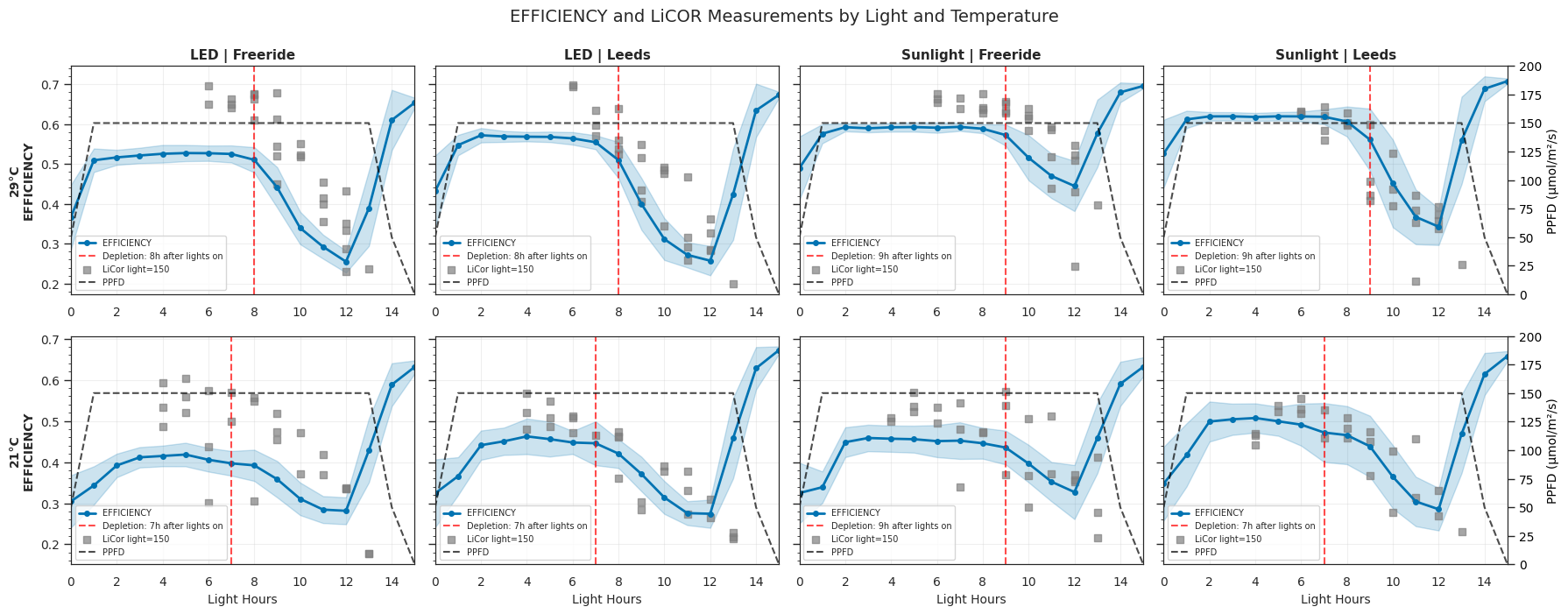
Figure 1. Gardin detected the drop in efficiency across cultivar, temperature and light source, with the timing of the drop varying between 7-9 hours of lights-on. Detection of the drop in efficiency was similar between Gardin and LI-COR.
Orchid Production Optimisation Saves Energy Costs
Many commercial orchid growers already dynamically adjust their supplemental lighting to a target daily light integral (DLI), especially during the darker months (Winter and Spring and Autumn shoulder season). However, DLI control does not account for daily variation in CAM physiology. Results from the case study showed that the timing of malate depletion varied with cultivar, temperature, and light source. As a result, even with a good DLI target, on some days high intensity lighting may still continue after malate depletion.
If we assume up to 2 h/day where lighting dimmed by 50% once malate depletion is detected (with an LED efficacy of 2.0 µmol/J), over peak Winter (16 weeks) this yields energy savings of up to 8.4 kWh m⁻². Equally, growers can save energy costs during Spring and Autumn (shoulder season), when some lighting is still applied to hit DLI targets. In this period, assuming up to 1 h/day of a 50% dimming over the combined 8-week shoulder season, this can add up to a further 2.1 kWh m⁻². In total, this represents annual energy savings of up to €21,000 per hectare per year at €0.20/kWh.
Conclusion
Real-time detection of CAM malate depletion enables growers to further optimise their production strategy. By dimming supplemental lighting when malate depletion is detected (during Winter and shoulder season) can generate annual savings of up to €21,000/Ha/y. This highlights the value of monitoring CAM malate depletion in real-time, on top of an existing DLI strategy. Gardin's fully autonomous, remote sensors continuously monitor a crop's photosynthetic performance, enabling growers to make confident decisions at scale.
Read the full scientific case study:
https://www.gardin.ag/casestudies/plant-lighting-orchid-case-study
Interested in how plant sensing could optimise lighting in your orchid production?
Visit please www.gardin.ag/contact to speak with the Gardin team
Also featured in: